Computer scientists have identified three levels of AI based on predicted growth in its ability to analyze data and make predictions. They call these levels:
- Narrow AI
- Broad AI
- General AI
As shown in the following graphic, Narrow AI, and Broad AI are available today. In fact, most enterprises use Broad AI. General AI won’t come online until sometime in the future.
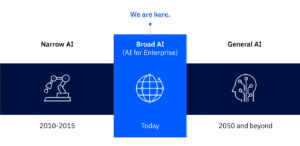
levels of AI
- Narrow AI is focused on addressing a single task such as predicting your next purchase or planning your day.
- Narrow AI is scaling very quickly in the consumer world, in which there are a lot of common tasks and data to train AI systems. For example, you can buy a book with a voice-based device.
- Narrow AI also enables robust applications, such as using Siri on an iPhone, the Amazon recommendation engine, autonomous vehicles, and more. Narrow AI systems like Siri have conversational capabilities, but only if you stick to the script.
- Broad AI is a midpoint between Narrow and General AI.
- Rather than being limited to a single task, Broad AI systems are more versatile and can handle a wider range of related tasks.
- Broad AI is focused on integrating AI within a specific business process where companies need business- and enterprise-specific knowledge and data to train this type of system.
- Newer Broad AI systems predict global weather, trace pandemics, and help businesses predict future trends.
- General AI refers to machines that can perform any intellectual task that a human can.
- Currently, AI does not have the ability to think abstractly, strategize, and use previous experiences to come up with new, creative ideas as humans do, such as inventing a new product or responding to people with appropriate emotions. And don’t worry, AI is nowhere near this point.
There might be another level, known as artificial superintelligence (ASI) that could appear near the end of this century. Then machines might become self-aware! Even then, no levels of AI are expected to replace or dominate you. Instead, scientists hope AI will extend humans’ ability to lead richer lives.
Ray Kurzweil, a noted futurist, has said:

Our technology, our machines are part of our humanity. We create them to extend ourselves and that is what is unique about human beings.
Ray Kurzweil, Forbes Magazine