Artificial intelligence machines (researchers call them “AI services”) don’t think. They calculate. They represent some of the newest, most sophisticated calculating machines in human history. Some can perform what’s called machine learning as they acquire new data. Others, using calculations arranged in ways inspired by neurons in the human brain, can even perform deep learning with multiple levels of calculations.
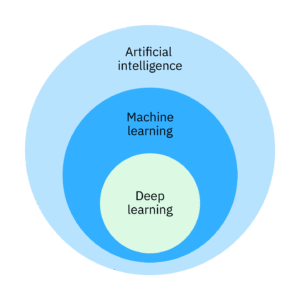 Imagine you are given the job to sort items in the produce department at a grocery store. You realize that there are dozens of products and very little time to sort them manually. How could you use artificial intelligence, machine learning, and deep learning to help with your work?
ARTIFICIAL INTELLIGENCE
To separate the stone fruits, berries, and tropical fruits, you could create a programmed rule in the format of if-else statements. This allows the machine to recognize what is on the label and route it to the correct basket.
A programmed rule might look something like this:
if berries_is_on_label:
route_items_to_center_basket()
else:
redirect_item_to_main_basket()
Artificial intelligence makes this process more efficient.
MACHINE LEARNING
To improve the performance of the machine, you expose it to more data to ensure that the machine is trained on numerous characteristics of each type of fruit. The more data you provide for the algorithm, the better the model gets. By providing more data and adjusting parameters, the machine minimizes errors by repetitive guess work.

The grocery store has expanded its produce selection to include more varieties such as nectarines and plums (stone fruits), blackberries and cranberries (berries), and mangoes and star fruit (tropical fruits). In addition, the products now come in different sizes, shapes, and colors. What makes deep learning different?
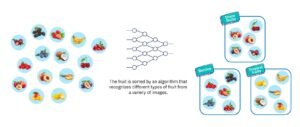
Deep learning models eliminate the need for feature extractions. For your work in the product department, you decide to use algorithms based on deep learning to sort fruit by removing the need to define what each product looks like. Feature extraction is built into the process without human input. Once you have provided the deep learning model with dozens of fruit pictures, it processes the images through different layers of neural networks. The layers can then learn an implicit representation of the raw data on their own.
How do AI services calculate? And, what do they do with those calculations? Let’s break this down into two parts. ANALYSIS AND PREDICTION
- ANALYSIS
AI services can take in (or “ingest”) enormous amounts of data. They can apply mathematical calculations to analyze data, sorting and organizing it in ways that would have been considered impossible only a few years ago.
- PREDICTION
AI services can use their data analysis to make predictions. They can, in effect, say, “Based on this information, a certain thing will probably happen.”
This is what AI services do! Based on data analysis, they make predictions. It might not seem like much, but that analysis and those predictions can have an enormous impact on human life.
Before you move on, take a moment to compare “analysis” and “prediction” to the guess you made earlier. Are you surprised? If so, you might be wondering how those two seemingly simple actions can be so important.