You learned previously about the three levels of artificial intelligence. The following image illustrates that the second level, Broad AI, is the current level.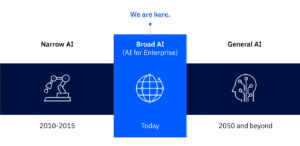
Activity
Now that you’ve been introduced to what AI does and how it works, you can review these levels with deeper insight. Think of at least one time you’ve encountered these levels in your own life.
Read the following paragraphs, reflect. (Writing an answer is a good way to process your thoughts. These answers are for your use only.
A few years ago, artificial intelligence technology advanced beyond what’s called Narrow AI. The advanced AI technology, such as the machine that beat Jeopardy!’s world champions, specializes in one area. It can look up information on which it has been trained. However, if you ask it to figure out a better way to store data on a hard drive, it will give you a “blank response.”
How have you experienced Narrow AI in your own life?
Today, people are surrounded by Broad AI, with capabilities that you’re reading about right now. Broad AI can structure vast amounts of unstructured data. It can also find and use patterns to make predictions that extend the expertise of humans who work alongside it.
How have you experienced Broad AI in your own life?
Now, consider your hopes or expectations for the predicted third level of artificial intelligence.
How do you expect to experience General AI later in your own life?
Think about this
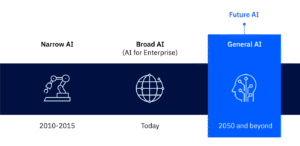
Perhaps, 25 years from now, General AI is expected to emerge. AI researcher Nick Bostrom defines this superintelligence as, “an intellect that is much smarter than the best human brains in practically every field, including scientific creativity, general wisdom and social skills.” You’re likely to see General AI appear in your lifetime. General AI will enable supersmart bots and technologies to link AI with the Internet of Things through “embodied cognition”. This will give machines the ability to interact in human-like ways as they work alongside humans.
What will interacting with general AI feel like to humans?
Select the following attributes for ideas on how humans might experience General AI in the future.
AI will move into all industries, from finance, to education, to healthcare. AI will increase productivity and enable new opportunities.
New technologies will sense, analyze, and understand things never before possible.
New forms of human-machine interaction and emerging technologies, such as conversational bots, will transform how humans engage with each other and with machines.
Machine interactions will be personalized for you, with new levels of detail and scale.
Billions of sensors generating exabytes of data will open new possibilities for improving Earth’s safety, sustainability, and security.
What’s beyond these wonders? Humans, devices, and robots might exist as a collective “digital brain” that anticipates human needs, makes predictions, and provides solutions. Farther in the future, we might trust the digital brain to do things on our behalf across a broad spectrum of endeavors!