People have analyzed data for centuries
 For centuries, people have struggled to understand the meaning that’s hidden in large amounts of data. After all, it’s one thing to estimate how many trees grow in a million square miles of forest. It’s something else to classify what species of trees they are, how they cluster at different altitudes, and what could be built with the wood they provide. That information can be difficult to extract from a very large amount of data. Because it’s hard to see without help, scientists call this dark data. It’s information without a structure: just a huge, unsorted mess of facts.
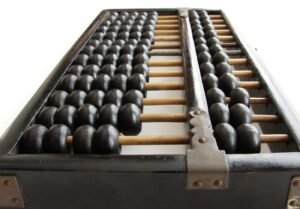 To sort out unstructured data, humans have created many different calculating machines. Over 2000 years ago, tax collectors for Emperor Qin Shihuang used the abacus—a device with beads on wires—to break down tax receipts and arrange them into categories. From this, they could determine how much the Emperor should spend on building extensions to the Great Wall of China.
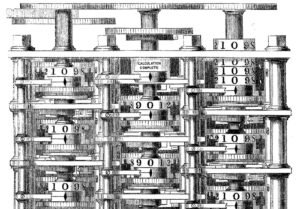 In England during the mid-1800s, Charles Babbage and Ada Lovelace designed (but never finished) what they called a “difference engine” designed to handle complex calculations using logarithms and trigonometry. Had they built it, the difference engine might have helped the English Navy build tables of ocean tides and depth soundings that could guide English sailors through rough waters.
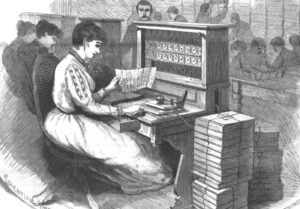 By the late 1880s, people were thinking about how to develop faster systems to record data. Herman Hollerith, inspired by train conductors using holes punched in different positions on a railway ticket to record traveler details, invented the recording of data on a machine-readable punched card. Hollerith’s cards were used for the 1890 US Census, which finished months ahead of schedule and under budget. Later versions of tabulating machines had broad applications in business, such as financial accounting and data processing.
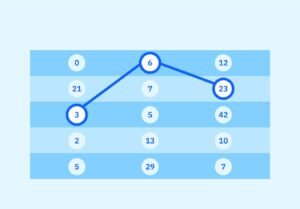
The word to remember across those twenty centuries is tabulate. Think of tabulation as “slicing and dicing” data to give it a structure, so that people can uncover patterns of useful information. You tabulate when you want to get a feel for what all those columns and rows of data in a table really mean.
Researchers call these centuries the Era of Tabulation, a time when machines helped humans sort data into structures to reveal its secrets.