A brief history of AI
The history of artificial intelligence dates back to philosophers thinking about the question, “What more can be done with the world we live in?” This question lead to discussions and the very beginning of many ideas about the possibilities involving technology.
Since the advent of electronic computing, there are some important events and milestones in the evolution of artificial intelligence to know about. Here’s an overview to get started.
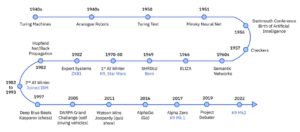
The Era of AI began one summer in 1956
Early in the summer of 1956, a small group of researchers, led by John McCarthy and Marvin Minsky, gathered at Dartmouth College in New Hampshire. There, at one of the oldest colleges in the United States, they launched a revolution in scientific research and coined the term “artificial intelligence”.
The researchers proposed that “every aspect of learning or any other feature of intelligence can be so precisely described that a machine can be made to simulate it.” They called their vision “artificial intelligence” and they raised millions of dollars to achieve it within 20 years. During the next two decades, they accomplished tremendous things, creating machines that could prove geometry theorems, speak simple English, and even solve word problems with algebra.
For a short time, AI was one of the most exciting fields in computer science.
But then came winter
Today, it is important for a computer to have enough processing power and memory. Every ad you see for companies like Apple or Dell emphasizes how fast their processors run and how much data they can work with. But in 1976, scientists realized that even the most successful computers of the day, working with natural language, could only manipulate a vocabulary of about 20 words. But a task like matching the performance of the human retina might require millions of instructions per second, at a time when the world’s fastest computer could run only about a hundred. By the early 1970s, it became clear that the problem was larger than researchers imagined. There were fundamental limits that no amount of money and effort could solve.
Even simple, commonsense reasoning requires a lot of information to back it up. But no one in 1970 knew how to build a database large enough to hold even the information known by a 2-year-old child.
As these issues became clear, the money dried up for The First Winter of AI.
The weather was rough for half a century
It took about a decade for technology and AI theory to catch up, primarily with new forms of AI called “expert systems”. These were limited to specific knowledge that could be manipulated with sets of rules. They worked well enough—for a while—and became popular in the 1980s. Money poured in. Researchers invested in tremendous mainframe machines that cost millions of dollars and occupied entire floors of large university and corporate buildings. It seemed as if AI was booming once again.
But soon the needs of scientists, businesses, and governments outgrew even these new systems. Again, funding for AI collapsed.
Then came another AI chill
In the late 1980s, the boom in AI research cooled, in part, because of the rise of personal computers. Machines from Apple and IBM, sitting on desks in people’s homes, grew more powerful than the huge corporate systems purchased just a few years earlier. Businesses and governments stopped investing in large-scale computing research, and funding dried up.
Over 300 AI companies shut down or went bankrupt during The Second Winter of AI.
Now, the forecast is sunny

In the mid-1990s, almost half a century after the Dartmouth research project, the Second Winter of AI began to thaw. Behind the scenes, computer processing finally reached speeds fast enough for machines to solve complex problems.
At the same time, the public began to see AI’s ability to play sophisticated games.
- In 1997, IBM’s Deep Blue beat the world’s chess champion by processing over 200 million possible moves per second.
- In 2005, a Stanford University robot drove itself down a 131-mile desert trail.
- In 2011, IBM’s Watson defeated two grand champions in the game of Jeopardy!

Today, AI has proven its ability in fields ranging from cancer research and big data analysis to defense systems and energy production. Artificial intelligence has come of age. AI has become one of the hottest fields of computer science. Its achievements impact people every day and its abilities increase exponentially. The Two Winters of AI have ended!